Tuesday, November 14, 2006

Discriminating Through the Minimum Wage

Now that Nancy Pelosi is going to be speaker of the house, we can look forward to her "first 100 hours." I'd like to call it her first 100 errors. She has put forth a list of things she wants to do in the first few days after taking control. Along with funding stem cell research, reversing the recent tax cuts, and investigating Bush and nearly all the Republicans, she plans to raise the minimum wage - possibly as high as $7.25. On the surface this seems like a good idea; raise the minimum wage so poor people can make more money. The problem is that it doesn't actually work that way.

The first myth to clear up is that people are not poor because of the minimum wage. The Bureau of Labor Statistics reports that in 2005 only 2.7% of employees working in the private sector and 1.1% in the public sector were earning at or below the minimum wage. But you must take into account who these 2.7% are. The BLS also reports that "About three in four workers earning $5.15 or less in 2005 were employed in service occupations, mostly in food preparation and service jobs," and these people generally make above minimum wage with tips. Of this small percentage making below minimum wage, half are under the age of 25 and a fourth are between the ages of 16 and 19. Only 15% of workers still earn minimum wage after 3 years. So, if only a very small portion of the population is making at or below minimum wage, then only a very small portion of the population can claim they are poor because of the minimum wage. In general, people are poor because they aren't skilled or productive enough to be worth more money.

In fact, it can be argued that people are unemployed because of the minimum wage. Let's say you own a business and you can afford to pay $30 per hour for labor. So, you hire 5 employees and pay them $5.15 per hour. We'll say it costs you $.85 for benefits (sick leave, workers comp, insurance) for a total of $30 per hour. If the minimum wage gets raised to $7.25 per hour it costs $8.10 per employee. Now you can only afford to hire 3 employees with benefits or 4 without benefits. Either way someone is unemployed, and it will most likely be the least productive employee who gets the pink slip.

Raising the minimum wage will only discriminate against the unskilled/uneducated and increase unemployment.
Monday, November 13, 2006

Are We Running Out of Oil?

"Non-renewable" "Limited" "Run Dry" - These are some of the buzzwords used in reference to oil. Many people are talking about the coming oil extinction, but are we really going to run out of oil soon? The NCPA (National Center for Policy Analysis) states that "Estimates of the world’s total endowment of oil have increased faster than oil has been taken from the ground." This is due to new technologies which increase the amount of oil that we can use as well as the discovery of new oil fields.

Ever since oil was first used for energy people have warned of its limited lifespan. It is beginning to sound like the Boy Who Cried Wolf. The NCPA lists many of the limited oil claims that turned out to be false, including an advertisement from 1855 - four years before the first U.S. oil well was even drilled!

The problem is that oil figures are actually much different from what is traditionally stated. When someone says, "We have enough oil for only 10 more years," they mean that with current technology and the number of oil fields we can/are using, without changing anything, we will have enough oil for 10 more years. A number of advances (such as the Electric Downhole Steam Generation process and the Discoverer Deep Seas) have increased the amount of "usable" oil. Also, large oil fields are being discovered which increase the number of possible sources.

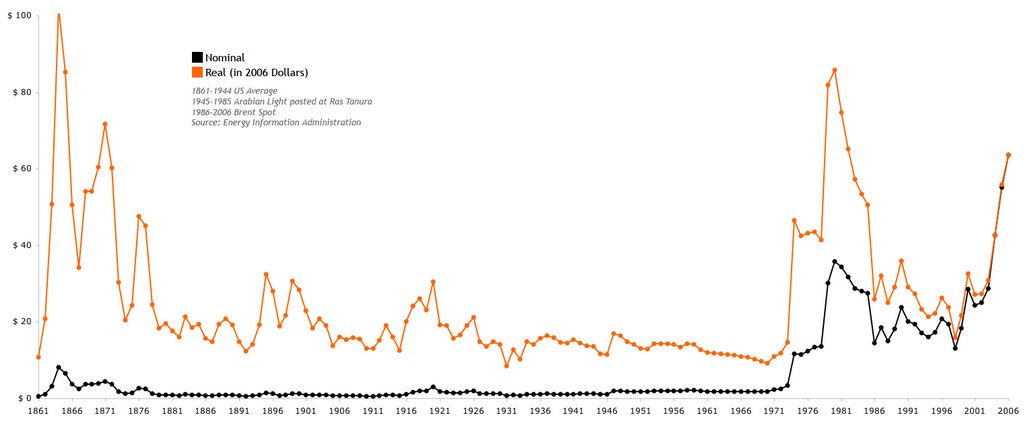
"But isn't the staggering increase in price due to a limited supply?" First of all, no. There are many things that can raise the price of oil (and I don't mean George Bush). Second of all, the price really isn't that high. Sure it seems high since it went up rather quick, but if you adjust for inflation we're not doing so bad as can be seen in the chart below (courtesy of Wikipedia).

Thursday, March 23, 2006

Should We Drill in ANWR?

There has been much debate in the past few years over whether or not we should be drilling for oil in ANWR (Arctic National Wildlife Refuge). Many people are oppopsed to it outright for environmental reasons. Other people support it outright for its potential contribution to the economy regardless of cost. However, few people are actually concerned with what impact this would really have.

Ted Stevens of Alaska, the most senior Republican in the Senate, has been fighting to open parts of the refuge to drilling since the early 1980s. Senator Lisa Murkowski, also a republican from Alaska, says, "We need ... to open up the small area of the coastal plain (of the refuge) for oil exploration and development." Their proposed legislation anticipates about $5 billion in federal revenue from oil leases.

According to the Alaskan Wilderness League ANWR is comprised of about 19 million acres. Currently this vast area is protected by the Alaska National Interest Lands Conservation Act (ANILCA), passed in 1980. SEction 1003 states that the “production of oil and gas from the Arctic National Wildlife Refuge is prohibited and no leasing or other development leading to production of oil and gas from the [Refuge] shall be undertaken until authorized by an act of Congress.” This sounds like the ban was not meant to be permenant, but is it now the time for drilling to be "authorized by an act of congress"? The Senate did pass a bill allowing ANWR to be drilled in the 90s but it was vetoed by then President Bill clinton.

Critics of the drilling bill offer up alternative methods of energy which could lower our dependence on oil such as wind, solar, hydrogen, and even human feces, however these are not going to impact our oil usage in the immediate future. The main objection to using ANWR for oil is the possible impact to wildlife, such as caribou, which are prevalent in the area. They also point to a U.S. Geological Survey which estimates that the energy that could be gained would be about what the U.S. consumes in six months. They say that only six months worth of oil is not worth it.

Supporters of drilling counter that argument by putting that six months worth of oil in perspective. The six months estimate means all the energy consumed, not just petroleum, so the U.S. Geological Survey is really saying we could get the amount of oil equivalent to about thirty years of imports from Saudi Arabia. That figure is hard to dismiss. They also look to current drilling efforts in Alaska, such as Prudhoe Bay, where the caribou herds have prospered.During debates over the drilling bill Senator Frank Murkowski pointed out in a floor speech that "This area, called ANWR, is pretty big, 19 million acres; 19 million acres is the size of the state of South Carolina... This area [the refuge's coastal plain] is 1.5 million acres out of 19 million acres. The House bill said we could only make a footprint of 2,000 acres. That is what we are asking in the amendment [that] we will offer in this bill – 2,000 acres of 19 million acres. Somebody in South Carolina that has a 2,000-acre farm can relate to that. Gee, only 2,000 acres out of our whole state. The rest of the state will be either a wilderness or a refuge." To put that into perspective the picture to the right shows ANWR as the gray area and the proposed 2000 acres as the red dot in the center.

Everyone agress that we need to diminish our dependence on foreign oil, it is just how to go about it that is up for debate. Perhaps Congress needs to allow a small amount of drilling to take place as a temporary fix and at the same time provide funding so we can actually put into place an alternative form of fuel, not just talk about it happening "some day".